// News item
Beam, Spot and Wash Lights – What's the Difference?
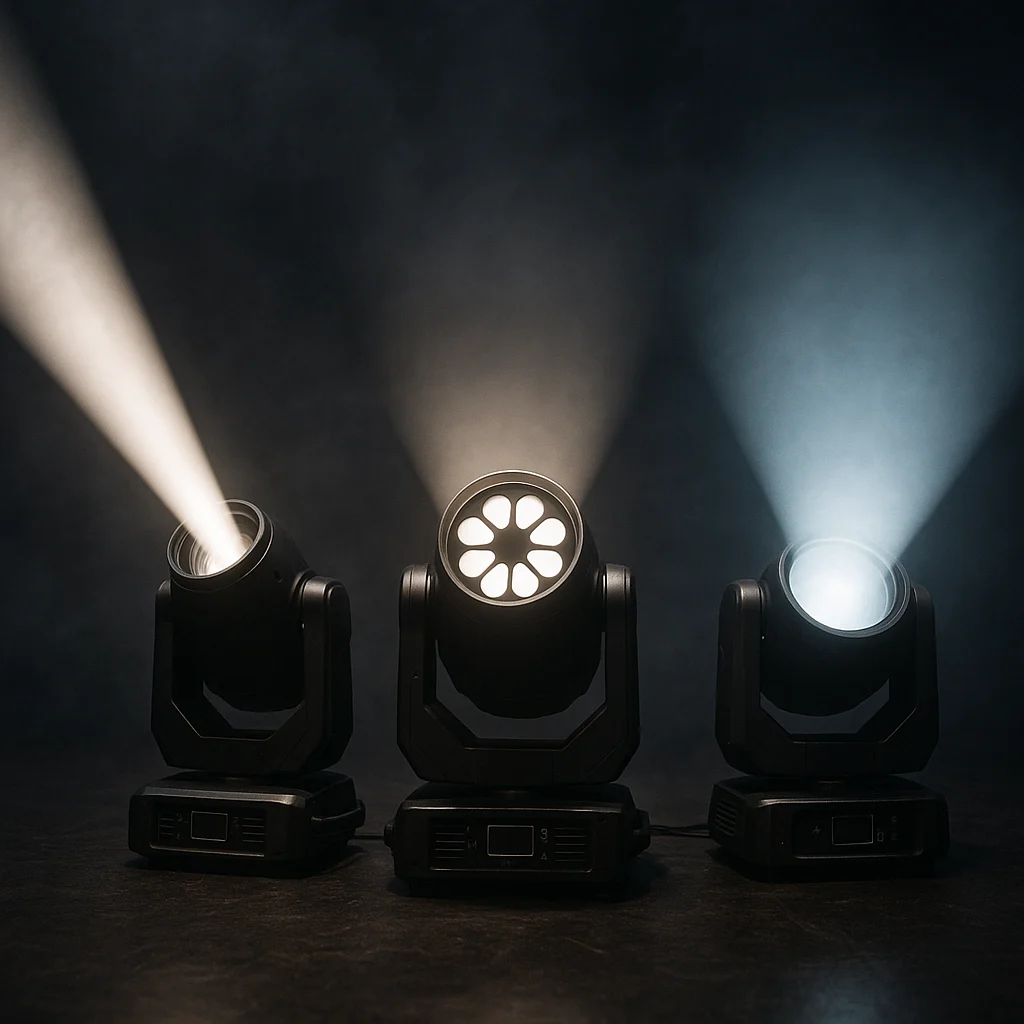
If you’re diving into stage or event lighting, you’ll quickly encounter these three magic words: beam, spot, wash. At first, it can seem pretty confusing, especially when the salesperson just says „well, it depends on what you want to do”. But don’t worry, it’s really not complicated – once you understand what each one is good for, you’ll never hesitate when making a choice again.
In this article, we’ll go through the differences between the three main moving head types, what to use them for, and how to choose which one you need for your own production.
What is a beam light?
The essence of a beam light is that it throws a very narrow, sharp beam of light. Just think: it’s like a laser-like beam cutting through space, and that beam itself is the visual effect. The light beam from beam lights is extremely intense, parallel, and barely spreads – that’s exactly why it’s so visible in smoke or hazy air.
These lights are typically not zoomable, or if they are, only within a very narrow range. Zoom isn’t even essential here: the beam light’s job is to deliver a clean, strong light beam that’s an effect in itself. At concerts and festivals, these are the beams that sweep across the sky above the crowd, making everyone say: „wow, that’s some professional lighting!”
From a practical standpoint: if you want spectacular, narrow light beams from a great distance, you need beam. If you’re working in a small club at close range, it might be too intense – spot or wash will be your friend instead.
What is a spot light?
The spot light is the versatile workhorse of the moving head family. It can project a sharp, well-defined light circle (or other shape), and this can be zoomed across a wide range – say from 8° to 45°, depending on the model. This means you can highlight a singer with a small, concentrated spot, or widen it to illuminate a larger area.
Spot lights can also be used with gobos (pattern templates), which let you project logos, patterns, text images onto walls or the stage. That’s why they’re indispensable at corporate events or theatrical productions, for example. Plus, most spot lights feature prisms, iris functions, and many other optical tricks to fine-tune the appearance.
The spot light’s tone is: „I’m the precise, adjustable work tool”. If you need contoured, sharp light that you can shape as you wish – you need a spot.
What is a wash light?
The purpose of a wash light is to create a soft, even light surface. No sharp outline, no hard shadows – instead, it floods the stage, dance floor or entire zone with broad, homogeneous light. The wash light is the background, the foundation that brings the whole picture together.
These lights are also zoomable (e.g., between 10°-60°), but what they deliver is always soft, transitional light. Perfect for color mixing – you smoothly wash the stage from blue to red, or create a warm orange atmosphere simulating a slowly rising sunset. If you use an LED wash light (which is practically standard today), RGBW or even RGBWA+UV color mixing gives you almost endless possibilities.
Without wash, most shows look like a half-finished cake – missing the frosting. That’s why it’s always worth having a few wash lights, even if beam and spot are more spectacular.
How do you choose which one you need?
I know, I know, the answer to every question is „you should have at least one of each”. But let’s try to break it down practically:
- Concert, festival, large space? You need beam lights. They’re spectacular, intense, and effective even from a distance. Plus, combined with a fog machine, they create a brutal effect.
- Corporate event, theater, precise projection? Spot is the star. Gobos, iris, zoom – these let you fine-tune, and everything goes exactly where it needs to.
- General background light, stage wash, soft atmosphere? Wash is the foundation. Without it, everything will look flat and cold.
- Mixed production? Combine them! For example, 2 beam + 4 spot + 4 wash – that’s already a perfectly respectable setup for a medium-sized event.
A good tip: if you have to choose one and you’re a beginner, start with a spot light. It’s the most universal – it can be narrow like a beam, it can be wide like a wash (though not as soft), and with gobos and prisms, it’s good for everything.
Technical differences and pricing
Beam lights are typically made with narrower optics, smaller lenses and higher-output lamps – that’s why they’re so bright. A professional beam light can easily perform at around 150-200,000 lux from a few meters away.
Spot lights have complex optical systems: zoom lens, gobo wheel, prism, color filters – these are all built in, which means additional mechanics and motors. Accordingly, they’re also more expensive, but they’re good for much more.
Wash lights work with simpler optics, but their performance in color mixing is unbeatable – especially with LED-based units. Their pricing generally falls between spot and beam, but there are also premium wash lights (e.g., RGBWA+UV, motorized zoom adjustment, frost filter).
Final tips: how to build a complete rig
If you’re serious about event technology, don’t build on just one type of light. A classic setup might look like this:
- 2-4 beam lights on the rear truss – these provide the aerial effects, the sweeping beams.
- 4-6 spot lights from the front or sides – with these you highlight, pattern, decorate.
- 4-8 wash lights evenly distributed – with these you wash the stage, provide background light, set the mood.
Plus, of course, you need a decent fog machine (because light without fog is like pizza without sauce), and a reliable DMX controller to keep it all under control.
If you have questions about which specific model is good for what – feel free to write to us, and we’ll help you put together the perfect setup for you. The important thing is not to let the jargon intimidate you: beam, spot, wash – these are just tools. The visual effect you create with them is in your hands.
